Tuesday, 16 March 2021

Change {part one}

Hello Friends ~~~ As the seasons turn it is with some surprise I feel caught unaware, and I realise this week sees the Vernal Equinox on March 20th,  we are half way through the first half of the year with Easter in a couple of weeks, and hurtling towards the Summer Solstice.  The days are growing deliciously longer, but to where did the year fly? How did it turn so quickly by? Some days seem so much longer than others as ferocious Winter gales  have pounded us and pushed us into Spring, yet surely and steadily Winter lies behind.

My thoughts turn to one word ~~~change~~~ and all the changes the turning seasons bring, each one in their own unique glory. As each season changes and turns, so our lives change and turn ~~~ yet there is a constancy to that change ~~~

Spring passes and one remembers one's innocence.
Summer passes and one remembers one's exuberance.
Autumn passes and one remembers one's reverence.
Winter passes and one remembers one's perseverance.” 
~~~Yoko Ono~~~

It goes without saying, we are, collectively, currently going through change of an unprecedented nature on a global scale.  Everything that was once the unchallenged familiar path we trod is now no longer straight or true.  Even when we are all vaccinated and have the virus on the run, I don't think we will ever be able to return to the world as it was a year and a half ago.  We are changed forever.  In some ways, I feel we are being given a second chance, but many are rejecting this opportunity to change our behaviour and put things right in our world.  From now on, my life will always be about Hands; Face; Space.

Recently, I was in my attic and came across something I made years ago, as part of an art course I took in 1998.  The group visited Castell Henllys, a recreation of an Iron Age Village, where we gathered research.  Upon our return to the studio we had three days to collate our research and then design and create a final outcome.  I confess, I may have gone into this with, what turned out to be, a completely unjustified preconception of how our ancient ancestors lived.  All that was about to change.

On the day we visited Castell Henllys, I was unwell with a feverish cold and after a short while exploring outside I hunkered down inside one of the huts where there was an open hearth with a roaring wood fire in the centre of the hut which radiated warmth, comfort, and cosiness to an extent that I'd never experienced before.  Any conceptions I'd ever had of how our Iron Age ancestors stayed dry and warm, protected from the elements, changed right at that moment and melted into the flames that seemed to dance across the centuries that lay between us, as my preconceived ideas disappeared up, dissolving with the rising smoke.

This was where the clan gathered, to eat, sleep {in beds around the edges of the hut} and tell their stories of an evening when the day's work was done.  I was amazed by the cleanliness and comfort as the conditions seemed primitive with a dirt floor; hewn logs for surprisingly comfortable, posture friendly seating; and an open space simply covered by woven fabric for an entrance which offered little or no protection from the elements, yet here I sat, incredibly comfortable, warm and dry, in the half light and in a haze of wood smoke.  More conceptions over comfort and community changed.

The walls of wattle and daub were adorned with decorated wooden shields, and the roof of tightly packed reeds raised high above my head supported by tree trunks and sturdy branches.  Somehow, it made up for the open door and I soon found myself forgetting that I was unwell. These people had building skills and took pride in their interiors by decorating them. Yet more conceptions changed.

I began to experience an immense and overwhelming feeling of connection to the natural world, and as if the spirits of the ancient ones were anchoring me to a new place of belonging, as I consciously drifted into another time. As I was becoming attuned, so I changed.

As my eyes adjusted to the low light, I let my gaze wander around the space and was amazed at the skill and craftsmanship, honesty and authenticity, in everything that came into my new found focus. Beautifully woven reed baskets, iron pots and pans, iron and wooden utensils, a fire dog, woven blankets on the beds, and woven curtains to separate the beds into cubicles, the guides dressed in woven garments that had a beauty only seen in hand dyed and hand woven cloth. These were made by a people who relied upon raw materials found in the environment around them.  Everything came from nature, and would eventually decay and return to the land from which it came; changed from what it was to become something else, and to change again as it no longer served its purpose.  And so my perceptions and conceptions continued to change.

I was particularly taken by the weaving looms, basic, yet quite recognisable as the forerunners of our modern day looms, and eventually these were the primary force behind the physical construction of my final outcome.  The skill and art of weaving seems to have remained a constant, having changed little over the millennia, other than the mechanisation.

These were a people who lived in a community, individuals but in harmony, together; at one with the land and nature; respect for each other and for the land on which they depended; who wasted nothing, and created artefacts that were both useful and functional, and beautiful.  My opinion of who they were and how they lived could not have been more changed.

At this particular time, I was going through great personal changes.  I was going through a divorce, a major life change which, as anyone who has gone through divorce knows brings changes on many, often complicated levels.  I also did not know that the insignificant cold I had was the start of a significant life long change in my health.

My final outcome had to reflect the profound emotional and abstract changes I experienced that day, as well as my physical observations, and it seemed fitting to bring everything together in a woven hanging.  I eventually constructed one by hand, from a mixture of found, reclaimed, and recycled objects, with an underlying feeling of disintegration, mutability, and change, which is how I responded to the information I had gathered ~~~ combined with the deep and meaningful personal experiences I was going through at the time, and representative of my love for, and work with textiles ~~~ as outlined in my process, following.


Back in the studio my research progressed and I processed my hand drawn sketches, photographs and other images along with my  experiences gleaned at Castell Henllys; two things seemed to stand out.  First, the were the way in which our ancestors utilised nature and found objects, changing them to purpose; and second, the mutability, the changeability, of those objects within the circle of life. Having changed from hunter~gatherers to settled farmers, the Iron Age Celts still relied on the bounty of nature for their food, medicine, clothing, shelter, enclosures and protection, weaponry, and more. We now know that they had a sense of aesthetic and, amongst other things, changed plants into dyes for colouring their cloth, their art, and their bodies.  Woad was a primary source of the particular shade of indigo blue associated with the period. They used trees and reeds that grew locally and changed them into beams and roofing for their constructions and animal pens, and grew grain to harvest and change into flour for food. I drew on all of these things, and more, bringing them together in a woven by hand wall hanging that was not precious in any way. I just let my hands respond to the found materials, and created something in full knowledge that the mutability, the changeability, of the materials chosen was part of the outcome.

Fallen sycamore seeds and grain husks as the piece deteriorates and falls apart returning to the earth


Lavender grown in, and gathered from, my garden incorporated into the weaving

Everything used was found and recycled materials, all in careful consideration with my theme Change.

I used found twigs and branches, wheat stalks, sycamore seeds, some old blue cord to recycle and to represent woad {I did not have the time to find woad and prepare it myself as I only had two days in which to complete the project} I brought everything together by hand, as they would have done in the Iron Age.  I incorporated seeds found at the site itself.


Roughly made clay weights created in response to Iron Age weaving looms


In the closing statement of my presentation, I emphasised the mutability, the changeability, how the Iron Age settlement had returned to the earth and was recreated again, how the circle of life continues, and how my weaving will slowly return to rejoin the earth from whence it came ~~~ ever changing, ever present ~~~

Over the years, twenty or more, that lie in between,  I have watched this weave do exactly what it was intended to do.  Change.

My Friends ~~~ we are in an unprecedented time of enormous change, where the only constants are the slow turning of the wheel of the year and the endless weaving of our stories, as we drift on unseen forces, from season to season. As the year turns, let us remember that as we move through Spring, our antipodean cousins move through Autumn ~~~ ever constant in the circle of the ever~changing year ~~~

Until next time
Stay safe, stay well.

Friday, 12 March 2021

A Tale of a Hundred Daffodils

Hello Friends!

I wandered lonely as a cloud
That floats on high o'er vales and hills,
When all at once I saw a crowd,
A host of golden daffodils;
Beside the lake, beneath the trees,
Fluttering and dancing in the breeze.

Continuous as the stars that shine
and twinkle on the Milky Way,
They stretched in never-ending line
along the margin of a bay:
Ten thousand saw I at a glance,
tossing their heads in sprightly dance.

The waves beside them danced; but they
Out-did the sparkling waves in glee:
A poet could not be but gay,
in such a jocund company:
I gazed—and gazed—but little thought
what wealth the show to me had brought:

For oft, when on my couch I lie
In vacant or in pensive mood,
They flash upon that inward eye
Which is the bliss of solitude;
And then my heart with pleasure fills,
And dances with the daffodils.

How could I write about daffodils and not include William Wordsworth's most famous poem?  What a sight he must have seen before him to inspire such moving and lasting imagery? 

The daffodil is the official flower of Wales, and is often worn by Welsh men, women, and children on March 1st, Saint David's Day, instead of the more pungent and less fragrant leek, also an emblem of Welsh nationality. 

Here is an amusing tale of what started out as just thirty daffodil bulbs that went forth and multiplied.  I didn't find it amusing as it unfolded, quite the opposite, but now I look back and I laugh.

Once upon a long, long time ago, in another lifetime, I lived in a tiny cottage overlooking a pretty bay and fishing harbour.  I knew I would not live there forever, so when I bought thirty Spring flowering daffodil bulbs, I planted them up in pots.  The flowered well and brought me much joy.


Time passed, and the day came when I had to move away, so I brought the pots of daffodils a few miles down the road to my parents cottage for them to plant out in their garden, and I went away.  I went away for four years, and during the Spring following my return, I was utterly amazed how the daffodils had multiplied.  They now filled the borders around the cottage making a delightfully colourful springtime display.


There was, however, one problem.

We all know how messy daffodils get once they have flowered and are dying back.  That was the rub.  There were, by now, so many daffodils that for weeks on end it all looked such a mess.  So, my mother and I came up with a plan.  


It was genius! Or so we thought.  I'd dig up all the bulbs from the borders, dry them off, store until September, then we'd pot them up into tubs of fresh compost that could then be put in the borders while in flower during early and mid Spring, and moved out of the way, out of sight, to die back in their unsightly manner, keeping the borders fresh and pretty.


I spent three days of back breaking work, digging out bulbs that, by now, had gone deep into the ground. We had over 300 bulbs!  I put them to dry, then stored away until needed.  


We bought the tubs; we bought bags and bags of compost.  Time passed, and we were ready to plant up the pots.


We set our pots up, began filling them with compost, and went to fetch the bulbs from the garden shed.  But wait! Where are the bulbs?  What has happened? Not a bulb to be found!  Not even an empty sack in which they were stored.  What had happened to the bulbs?


We puzzled for ages, not realising that there was a rather large square of freshly dug soil in a corner of the garden.  When my father came home, we asked him if he knew anything about the missing bulbs, and to our dismay he cheerfully told us that, the previous day, he'd only gone and dug them back in, they were under all that freshly turned soil.

You can go off people, and you can go off daffodils!  My father thought it was funny; he and I had words.  Not for the first, nor the last time over gardening differences of opinion.


I got over it, and the daffodils flourished in their new home, but over the years they multiplied even more, so I dug them up and gave them away.  There's only so many daffodils a small garden can hold, after all. 


Probably the prettiest are the double ones, but sadly they tend to succumb to the bad, Spring storms that prevail during March, right as they begin to flower, so this year, with advance warning of an impending week of wild, wet and windy Welsh weather, I picked them and brought them in, in tight bud.  If you've scrolled this far, you've seen their progress, but, sadly, this was the scene that greeted me this morning. 


I guess they keep on growing and getting heavier after they've opened and keep on drinking up the water.  So sad to see their slender stems bent over with the weight, but it is what it is, and short of wiring them there's very little I can do to prevent this happening.

At least I've had a few days enJOYment from them, while yet another week of Spring storms lashed our coast from Tuesday until Sunday.


For those of you who don't know, the stoneware jug is over seventy years old and was a gift from my dear mother to  her mother.  It is now in my care, and I have always loved this jug, even more so now.  As a child, I loved to see it on a table filled with daffodils which seem to look so well in it.  I named it the Daffodil Jug, and it is known by that name to this day.


Until next time
Stay safe and stay well.

Sunday, 7 March 2021

Pretty as a Picture

 Hello Friends!

The other day, I somehow found myself sifting through the contents of a long forgotten tin sitting on a long forgotten corner on a long forgotten shelf in the garage {which is now more of a garden shed than a garage as I don't drive}, and look what I found!  Of course, the seeds will no longer be viable, for these are dated mid 1970's, but the last hands to touch these were my dear Daddy, who loved to garden from plot to plate in his spare time.  

They certainly knew how to make their seed packets look so pretty and inviting back then.


Even the instructions are illustrated prettily


Even the wording is written more like you are being spoken to directly, rather than a short list of instructions, or worse, the packets that only have graphs and guesswork.


They even come with instructions to dry the herbs!


The packets are a little bit dusty and marked, but I will try to gently clean them off to use in some project, as yet to be determined!

Soon I will be starting to sow my seeds for this year's food, but the packets are nowhere near as pretty!

Photos may give a more accurate and instant impression of the contents, and are boldly bright and beautiful, but I know which ones I prefer.


I had my vegetable seeds order back in early February.  When it arrived, I realised I'd forgotten to order my annuals, so I put in a small order for those, and these are what I ordered.  However, when this arrived last week, I immediately realised I have forgotten my pansies and borage seeds.  Heigh ho!  

Until next time
Stay safe, stay well
Deborah xo 

Monday, 1 March 2021

DYDD GÅ´YL DEWI SANT

 Hello Friends!

The Shrine of David, St Davids Cathedral.  L to R Saints Patrick, David, Andrew

DYDD GÅ´YL DEWI SANT HAPUS
Happy Saint David's Day

Thank you for all your lovely comments on my last blog two days ago concerning the local Saint David's Day Eisteddfod, and now, today is March 1st, the day when Welsh people, and people of Welsh heritage, all over the world celebrate the life of our Patron Saint, Dewi Sant, or Saint David.

Very early example of a Celtic Cross at St Non's Chapel {ruins}

Dewi was born around 500 A.D..  He was the son of a Welsh noble woman and nun, Non.  Much of what we know of his life and hagiography was committed to parchment 500 years after his death, in the 11th century by Bishop Rhygyfarch in the book "Life of David" or "Buchedd Dewi".  The "facts" being handed down through the centuries between by the oral traditions of story telling.  His exact age is unknown, and some sources would have us believe he lived to the age of 147 years, but he did live a long life of service dedicated to God.

Although known by the Anglicised name David , his Welsh name is Dewi.


The following account is how I recall what I learned about the history of Dewi Sant in school and as I grew up.  The accompanying images are all important locations in the life of Dewi and his mother, Non.

He was born on the high cliff tops overlooking Saint Bride's Bay during a raging thunderstorm.  Such was Non's pain, her fingers clawed at a stone which rent asunder in sympathy with her agony, and which is now incorporated in a nearby altar.  A healing well sprung up on the spot, and is there to this day.  Its specific healing properties are to heal complaints of the eyesight.


The rock formation, above, is known as Beddau Non, or Non's Grave {although her actual grave is in Brittany} and below is her icon at the rear of the Shrine at St David's Cathedral.


These are the ruins of a mediaeval church built in the field near to the spot of Dewi's birth


And, this is the well that sprung up during the thunderstorm


This shrine to the honour of the Virgin Mary is situated opposite the well


And, nearby is a 20th century chapel, built in 1934 and dedicated to Our Lady and Saint Non.  It is tiny, seating around a dozen or so, and I do think this is my most favourite altar {below}, along with the altar in Trinity Chapel at St David's Cathedral.


An image of Saint Non contained within the chapel


Dewi was a humble man, an early Celtic Christian, of deep faith, who founded a monastic settlement in the valley just below where I live, Glyn Rhossyn, or Vale of Roses.  He lived a simple, frugal life of abstinence, refraining from eating meat or drinking beer, living only on water, bread, salt, and herbs.  The monks tended the land without the use of animals, and they are known to have kept bees.

He spent many hours, up to his neck, in the cold waters of a nearby river, or in the sea, reciting psalms and praying, as a form of penance. 

It is hardly surprising, therefore, to learn he is often known as "The Waterman".

Many miracles of healing are attributed to Dewi, but his best known miracle was when he stood in the centre of a large crowd at the Synod of Brefi, but as he addressed them, the crowd was so great that many could not see him.  He placed a small cloth on the ground which the ground then rose up to form a small hill from which all could see and hear him speak.

At this moment, a white dove came and settled upon his shoulder, and now Dewi is depicted with this in illustrations.

He also healed the failed eyesight of his teacher, the monk Paulinas, who had become totally blind from old age.  I wonder if this has a connection with the eyesight healing properties associated with the healing well?

On his Feast Day, Welsh people proudly wear a leek on their coat. Legend has it that St David suggested Welsh soldiers wear a leek on their helmets to distinguish them from the invading Saxon soldiers who wore similar uniforms. The leek features in the uniforms of Welsh regiments to this day.

He became a renowned preacher, and founded many churches and monasteries across south and west Wales, and Britany, many of which are still in evidence today.

A little known fact is that Dewi, or David, is the only British saint actually born in the country of which he is Patron Saint. 

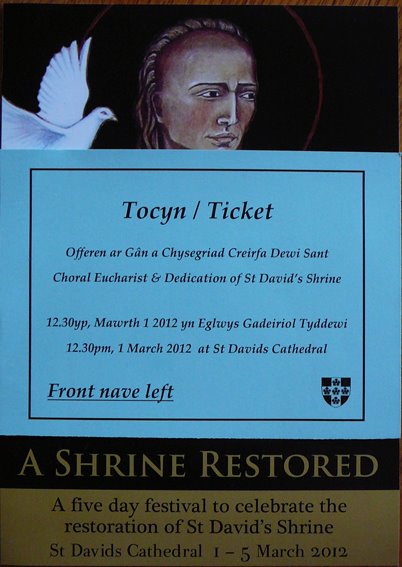
Upon his death, March 1st circa 589 A.D. he was buried at his own monastery in the Vale of Roses.  His remains were later moved to the mediaeval shrine, built in his name and honour, in St David's Cathedral, which was recently restored in 2012.  I was honoured to be in the congregation for the service of dedication.

The Shrine, restored, adjacent to the Presbytery.  His shrine was so important that Pope Callistus II declared two pilgrimages to St Davids were equal one to Rome, while three pilgrimages to St Davids equalled one to Jerusalem.  {the tomb to the foreground is that of Edmund Tudor, father and brother of Kings}

Every Friday, at noon, within strict lockdown guidelines, the Cathedral broadcasts weekly Prayers from the Shrine which you can find on both their YouTube channel and live on their Facebook page.  In normal times, the prayers are preceded with a short pilgrim's walk from St Davids to Saint Non's Chapel and Well, before returning to the Shrine by midday.  One day, very soon, I hope the freedom to do this again will be returned to us.  For now, it is a focal point of my week from my living room.

There now stands, as was described recently by a travel magazine, a "whopping mediaeval cathedral" on the site where it is widely believed Dewi's settlement originally stood.  The building of the present cathedral began in 1181, and it has a rich and diverse history, full of prosperity and peril, as does the site in general dating back 1500 years to Dewi's monastic days, until we see the building as it stands before us in it's present form.


The last words he spoke to his followers were

“Be joyful, keep the faith, do the little things you have seen me do”.

which are still associated with him today.


Our usual celebrations, as outlined in the blog I published yesterday, will not be happening this year, but there is every hope they will take place as normal next year, as we gather to celebrate our Patron Saint once more.


Until next time
Stay safe, stay well
Deborah xo