Showing posts with label Patron Saint of Wales. Show all posts

Monday, 1 March 2021

DYDD GŴYL DEWI SANT

 Hello Friends!

The Shrine of David, St Davids Cathedral.  L to R Saints Patrick, David, Andrew

DYDD GŴYL DEWI SANT HAPUS
Happy Saint David's Day

Thank you for all your lovely comments on my last blog two days ago concerning the local Saint David's Day Eisteddfod, and now, today is March 1st, the day when Welsh people, and people of Welsh heritage, all over the world celebrate the life of our Patron Saint, Dewi Sant, or Saint David.

Very early example of a Celtic Cross at St Non's Chapel {ruins}

Dewi was born around 500 A.D..  He was the son of a Welsh noble woman and nun, Non.  Much of what we know of his life and hagiography was committed to parchment 500 years after his death, in the 11th century by Bishop Rhygyfarch in the book "Life of David" or "Buchedd Dewi".  The "facts" being handed down through the centuries between by the oral traditions of story telling.  His exact age is unknown, and some sources would have us believe he lived to the age of 147 years, but he did live a long life of service dedicated to God.

Although known by the Anglicised name David , his Welsh name is Dewi.


The following account is how I recall what I learned about the history of Dewi Sant in school and as I grew up.  The accompanying images are all important locations in the life of Dewi and his mother, Non.

He was born on the high cliff tops overlooking Saint Bride's Bay during a raging thunderstorm.  Such was Non's pain, her fingers clawed at a stone which rent asunder in sympathy with her agony, and which is now incorporated in a nearby altar.  A healing well sprung up on the spot, and is there to this day.  Its specific healing properties are to heal complaints of the eyesight.


The rock formation, above, is known as Beddau Non, or Non's Grave {although her actual grave is in Brittany} and below is her icon at the rear of the Shrine at St David's Cathedral.


These are the ruins of a mediaeval church built in the field near to the spot of Dewi's birth


And, this is the well that sprung up during the thunderstorm


This shrine to the honour of the Virgin Mary is situated opposite the well


And, nearby is a 20th century chapel, built in 1934 and dedicated to Our Lady and Saint Non.  It is tiny, seating around a dozen or so, and I do think this is my most favourite altar {below}, along with the altar in Trinity Chapel at St David's Cathedral.


An image of Saint Non contained within the chapel


Dewi was a humble man, an early Celtic Christian, of deep faith, who founded a monastic settlement in the valley just below where I live, Glyn Rhossyn, or Vale of Roses.  He lived a simple, frugal life of abstinence, refraining from eating meat or drinking beer, living only on water, bread, salt, and herbs.  The monks tended the land without the use of animals, and they are known to have kept bees.

He spent many hours, up to his neck, in the cold waters of a nearby river, or in the sea, reciting psalms and praying, as a form of penance. 

It is hardly surprising, therefore, to learn he is often known as "The Waterman".

Many miracles of healing are attributed to Dewi, but his best known miracle was when he stood in the centre of a large crowd at the Synod of Brefi, but as he addressed them, the crowd was so great that many could not see him.  He placed a small cloth on the ground which the ground then rose up to form a small hill from which all could see and hear him speak.

At this moment, a white dove came and settled upon his shoulder, and now Dewi is depicted with this in illustrations.

He also healed the failed eyesight of his teacher, the monk Paulinas, who had become totally blind from old age.  I wonder if this has a connection with the eyesight healing properties associated with the healing well?

On his Feast Day, Welsh people proudly wear a leek on their coat. Legend has it that St David suggested Welsh soldiers wear a leek on their helmets to distinguish them from the invading Saxon soldiers who wore similar uniforms. The leek features in the uniforms of Welsh regiments to this day.

He became a renowned preacher, and founded many churches and monasteries across south and west Wales, and Britany, many of which are still in evidence today.

A little known fact is that Dewi, or David, is the only British saint actually born in the country of which he is Patron Saint. 

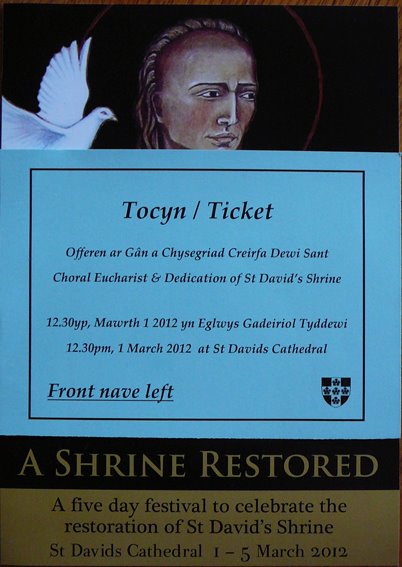
Upon his death, March 1st circa 589 A.D. he was buried at his own monastery in the Vale of Roses.  His remains were later moved to the mediaeval shrine, built in his name and honour, in St David's Cathedral, which was recently restored in 2012.  I was honoured to be in the congregation for the service of dedication.
The Shrine, restored, adjacent to the Presbytery.  His shrine was so important that Pope Callistus II declared two pilgrimages to St Davids were equal one to Rome, while three pilgrimages to St Davids equalled one to Jerusalem.  {the tomb to the foreground is that of Edmund Tudor, father and brother of Kings}

Every Friday, at noon, within strict lockdown guidelines, the Cathedral broadcasts weekly Prayers from the Shrine which you can find on both their YouTube channel and live on their Facebook page.  In normal times, the prayers are preceded with a short pilgrim's walk from St Davids to Saint Non's Chapel and Well, before returning to the Shrine by midday.  One day, very soon, I hope the freedom to do this again will be returned to us.  For now, it is a focal point of my week from my living room.

There now stands, as was described recently by a travel magazine, a "whopping mediaeval cathedral" on the site where it is widely believed Dewi's settlement originally stood.  The building of the present cathedral began in 1181, and it has a rich and diverse history, full of prosperity and peril, as does the site in general dating back 1500 years to Dewi's monastic days, until we see the building as it stands before us in it's present form.


The last words he spoke to his followers were

“Be joyful, keep the faith, do the little things you have seen me do”.

which are still associated with him today.


Our usual celebrations, as outlined in the blog I published yesterday, will not be happening this year, but there is every hope they will take place as normal next year, as we gather to celebrate our Patron Saint once more.


Until next time
Stay safe, stay well
Deborah xo

Wednesday, 1 March 2017

Daffodils, Pancakes and A Patron Saint

Hello Friends!

DAFFODILS FOR SAINT DAVID'S DAY

It's been quite a busy few days in the village as it is March 1st, and that means it is Saint David's Day, the day we celebrate the Patron Saint of Wales.  You can read all about it here and here  where I have previously shared several of our events and a little of the history of David himself.

I was unable to attend in person at any of the events this year, however, I did manage to take a few photographs of some of the many windows that have been so beautifully decorated in celebration of Saint David. Here are a few of them, a bit shaky as it was like standing in a wind tunnel out there today in 50 mph winds ~~~


I love these quirky pottery Welsh ladies


Here are some of my personal things, some table linen, a Welsh lady doll that is dressed in traditional costume that someone lovingly knit by hand, and a few towels and oven gloves with Welsh patterns ~~~


and a plate of delicious Welsh Cakes, a yummy treat to have with tea on St David's Day ~~~


We also have dear friends living Across the Pond who celebrate Wales and they share their lovely pictures and celebrations with us ~~~


Yesterday was Shrove Tuesday, which you can read about here, however, many of you celebrate this day yourself in one of its many forms as it is celebrated across the world and I'd love if you'd share your stories in the comment ~~~

I don't like calling it Pancake Day as I observe it as Shrove Tuesday, the day before Ash Wednesday, and the start of Lent, although, as a child, we sang the following little ditty all day long in school, in eager anticipation of delicious pancakes, fresh from the frying pan, for our tea when we got in from the cold, and often wet, walk home from school ~~~

Pancake Day! Pancake Day!
Mother's Busy Baking 
Toss the Pancakes! Toss the Pancakes!
Turn the Pancakes Over!

I always remember my mother, slaving over the hot stove which stood in the corner of the tiny room where we cooked, ate, and sat around the fire of the evenings, making the pancakes one by one so each of us got a fresh, hot pancake slathered in melted butter, sprinkled liberally with sugar, and drizzled with lemon juice. She would serve everyone first before sitting down to her own, then start again giving each one of us a fresh pancake in turn, ending with her own, until all the batter was gone! My goodness, they were tasty treats with all the sugar and butter!

We sat, in eager anticipation, not only of the delicious pancakes, but waiting for The Toss! No meal of pancakes is proper without the successful toss of at least one pancake!  I pride myself on my expertise in this field!

Here is my recipe for crêpes which I learned in school, many decades ago ~~~

4 oz plain flour, sifted with a pinch of salt into a mixing bowl. Make a well in the centre and into this crack two large eggs. Gradually incorporate the eggs into the flour, slowly drawing the flour into the eggs. When all the flour is absorbed by the eggs, slowly pour in 1/2 pint of full cream milk beating constantly using a hand held electric whisk. You may, of course, whisk by hand using a balloon whisk should you require to burn off calories before eating your treat!  Set batter aside for a minimum of 1 hour before using. Immediately before using, pour 1 oz melted butter into the batter and whisk well.
To cook the pancakes, heat a heavy flat based pan and lightly grease with butter. When the butter begins to give off a blue smokey haze the pan is ready. Pour about 1/6 of the batter into the pan and swirl around until it reaches the edges. When the top is dry and the pancake slides freely in the pan, flip using a spatula, or toss if you are brave enough and cook the other side until golden brown.
Transfer the cooked pancake to a warm plate and flavour or fill with your choice of toppings before serving immediately. Repeat with remaining batter, which makes approximately 6 pancakes of 10 inches diameter. Bon Appetit!

Our traditional Shrove Tuesday pancakes are globally called crêpes, those heavenly, paper thin French confections of pure, soft, melt in the mouth delight which I love dearly. Today, pancakes will be made in many shapes, sizes, and filled with all manner of treats.  These are mine ~~~


I don't mind savoury or filled sweet pancakes at any time of year, and love them filled with garlic mushrooms; roasted Mediterranean vegetables; broccoli in a cheese sauce; ice cream and chocolate sauce; fresh fruit and a brandy sauce; you get the idea ~ but on Shrove Tuesday they are simple fare served in remembrance of the day.

Did you have pancakes yesterday, or do you have other ways of celebrating Shrove Tuesday?

Until next time ~~~
~~~ Deborah