Showing posts with label Gifting. Show all posts

Friday, 9 December 2016

Christmas Countdown and Traditions Day Nine

Hello Friends!

It is December 9th, so here is the image and scripture from the Advent calendar for today ~~~


and here is how the calendar looks so far, with the first nine doors opened ~~~


Today's tradition I will share is the observance of Boxing Day.

Christmas Day in the United Kingdom is followed by Boxing Day on December 26th.  It is a secular holiday so called because it is the day when servants or tradesmen would receive their 'Christmas Box', a cash gratuity, from their masters, customers, or employers.

A Christmas Box was, and often still is, a gift of money in recognition of work throughout the year. In bygone days the Christmas Box was an important source of extra income.  Even today, when we give a tip to postmen, refuse collectors, hairdressers and beauticians, etc. it is called their "Christmas Box" {although this is no longer given on December 26th} in recognition of the distant origins.

Boxing Day is a holiday tradtion I grew up with, and frankly I never understood what it was about until I was much older. During my research for this I came across another interesting related snippet which is that servants and workers kept sealed stoneware boxes in their rooms or cottages in which they kept the tips they received throughout the year. On December 26 they traditionally broke open the boxes to access the money accrued through the year, hence the name 'Boxing Day' ~ I had not heard of this before, but it adds another layer of interest to the interpretation.

Christmas Boxes were often spent on little luxuries that otherwise were not affordable, and also on sweet treats sold by the numerous street vendors of the day. This goes a long way to explaining why, at Christmas time, I always felt my mother was stocking up the home for a ten day siege! Although we were not in reciept of a Christmas Box, I know she kept a little box in the sideboard in the parlour so she could save regularly throughout the year to provide a sumptuous feast for the family between Christmas Eve and New Year's Day when we ate like the kings and queens of old!

The gifting of Christmas Boxes was not an insignificant gesture. Considering the average well~to~do household over the course of twelve months might employ, in addition to their own staff and servants, the following tradesmen: butcher, green grocer, brewer, fishmonger, poulterer, dustman, watchman, lamplighter, seamstress, carpenter, glazier, blacksmity, tallow chandler, grain chandler, baker, and so on and so forth, not forgetting the person who sells brick dust to your footman for the polishing of knives, and not to mention that every apprentice who works for all of your main suppliers and tradesmen would be sure to make themselves known to you on Boxing Day too then the giving of a Christmas Box was an expensive thing to do.

We do not like to be done out of an extra day off work, so if Boxing Day falls on a weekend, then a Bank Holiday is taken on the first working day that follows {to complicate matters, if Christmas Day falls on a Saturday, and Boxing Day on a Sunday then the next two working days being Monday and Tuesday are taken in the form of Bank Holidays, so it can be a four day weekend}.

Across much of Europe, the 26th December is known as St Stephen's Day, or the Second Day of Christmastide and is observed as such with different traditions or customs pertinent to each country.

Until next time ~~~
~~~Deborah xoxo

Thursday, 10 July 2014

Raspberry Jam

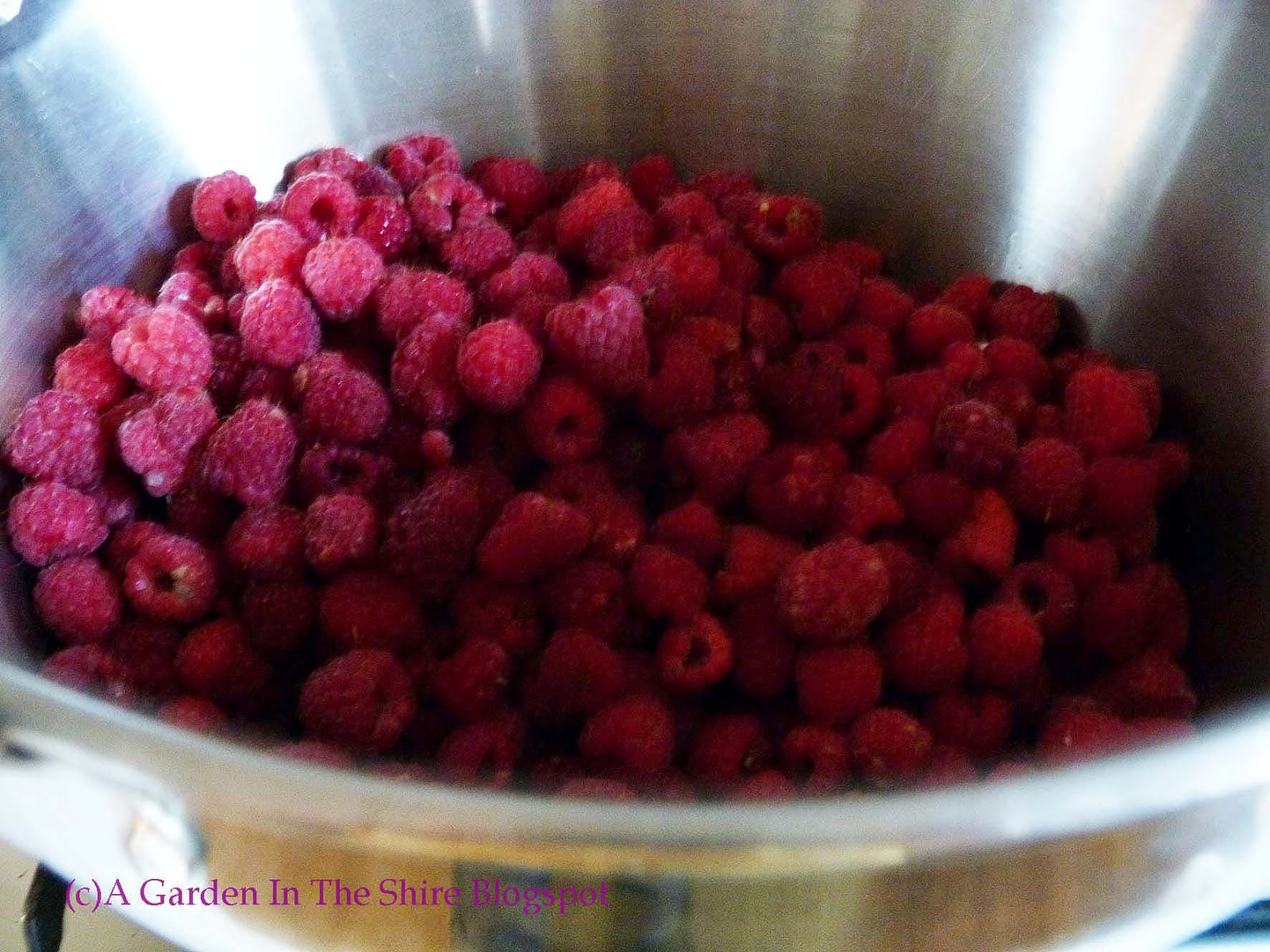
Gentle Reader ~~~ raspberries galore means one of my most favourite jams is being made ~ the first batch of the season ~ in my kitchen this morning.

Usually, I pick small quantities of berries each morning and freeze them in small batches to make jam in the winter months ~~ this is a lovely thing to do during the dark, cold days of winter, when the winds are howling around the corners of my cottage, and the sun struggles to lift it's head out of bed, for it fills the cottage with the fragrant scents of summer berries and warmth, and gives something extra delicious to spread on toast or to fill a Victoria sponge.

I came to preserving several years ago when five courgette plants gave an incredible yield of fruits and that is when I found out how many people do not actually like courgettes {knock me down with a feather! I love courgettes!} and I could not give them away for love nor money.  I reckon that people who don't like courgettes have not had them properly cooked ~ they have had them as a watery mess either boiled {as I have seen some folks do, and I would not like them either} or in a badly made ratatouille {of which I ate my share in the 1980's} Now, don't get me wrong, I love ratatouille, but I like it a certain way and not full of overcooked, mushy vegetables.  More on that another time.  So, what to do with a glut of courgettes ~ even someone with my love of this fruit can only eat so many and it did not take long for my salad box to be overflowing.

Then, as serendipity would have it, I stumbled across a National Trust book that had a recipe for "Polesden Lacey's Courgette Chutney"  I'd never thought of preserving them, to be honest I thought there was a mystery beyond my ken for preserving.  The recipe looked easy enough, so I acquired a copy and off to my kitchen I went ~~ within a few hours I had made my first ever batch of chutney, my first ever attempt at making anything preserved at all.  I was over my mental block!  I put up jar upon jar upon jar that Autumn and suddenly I had no room in my kitchen store cupboards for anything else so I started, with a little trepidation, to give jars away.  I was anxious because I was giving this courgette chutney to people who did not like courgettes, and it was my first batch so it was up for judgement too!  To my immense relief everyone loved it!  Since then, it has become a big hit in my home made Christmas hampers that I give to friends and relatives too.  The rest as they say, is history.

These days, I make chutneys, pickles, jams, jellies, and all sorts of preserves.  My most favourite things to make are, naturally, preserving with things I grow myself.  I've invested in a proper preserving pan, I got mine from Lakeland Ltd, and they have a good range of preserving equipment.  Of course, other sources for supplies are available!

My recipe for jam is simple, and it is roughly the same whatever fruit I am using.  For every one pound of fruit use one pound of sugar.  How simple is that?

Here is my recipe for Raspberry Jam ~~

3lb of freshly picked, slightly under~ripe raspberries


3lb of sugar {I use preserving sugar which has added pectin to aid the setting}


You will need a preserving pan or large heavy bottomed saucepan, baking tray, sugar thermometer, ladle, wide mouth metal funnel {optional} sterilised jam jars and lids, wax paper lids {optional}, and labels.

  •  Pick the fruit over to remove any hulls and debris.  Place in a preserving pan and warm very gently to release the juices and cook the fruit ~ about 20 minutes.  

  • While this is happening, warm the sugar on a shallow tray in a low oven {this helps speed up the cooking time and ~hopefully~ stops the fruit breaking down so the jam has pieces of fruit in it}
  • Add the warmed sugar to the cooked fruit and heat gently until the sugar is dissolved.  Bring to a rapid boil and boil until 'setting point' is reached.  I use a jam thermometer with the setting marked.


  • While the jam is reaching setting point, wash your jars and lids in warm, soapy water, rinse well and dry, and place on a baking tray in a low oven to sterilise the jars and lids.
  • When the jam is ready, allow to cool slightly before carefully ladling into the sterilised jars.  A wide mouth metal funnel is very useful for this.  Place a waxed paper disk {if using} on top of the hot jam to help create an airtight seal.  Place the lid on and lightly screw down, tightening fully when the jars of jam are cool enough to handle.

Oh, and it is a good idea to have a few spare plates on hand to catch all the drippy bits!  You can eat these later, on fresh, crusty bread ~ cook's perks!


  • Label with the date and store in a cool, dry place.  Jam can be eaten immediately, but is better after about a month to mature, and keeps for a year, or longer {it never lasts that long in this cottage}

As this batch is not for gifting, I used ordinary, recycled jam jars, but if giving as gifts use pretty or unusual jars, if you have them, and make hand~written labels and cloth covers for the lids and tie using pretty ribbon, raffia, or twine.


Remember ~~~ 


~~~A Gardener's Work Is Never Done~~~